Tackling Needle Pain—Before, During, and After: A Q&A with the Founder of Thimble
Dr. Dawkins built Thimble to tackle what most numbing products ignore: fast, mess-free pain relief designed specifically for needle procedures—before and after the shot.
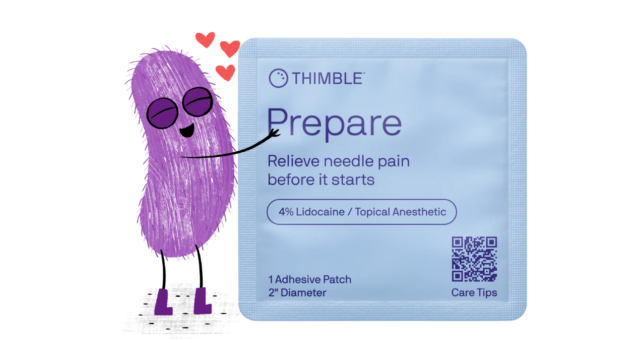
At the Meg Foundation, we’re all about evidence-based strategies to prevent and manage pain, especially when it comes to needle procedures. That’s why we were excited to talk with Dr. Dawkins, physician, mom, and founder of Thimble—an over-the-counter platform designed to reduce the pain and anxiety associated with needle procedures. In this Q&A, we dig into the origin story behind Thimble, how it compares to other numbing options like EMLA, and why post-injection pain care deserves more attention than it gets.
Why needle pain needed a better solution
Meg Foundation: Let’s start with the “why.” What inspired you to create Thimble?
Dr. Dawkins: As a physician, I was familiar with needle pain. But as a mom, it hit differently. I’ll never forget taking my older daughter in for her first shots. The look of fear and betrayal on her face shook me. That moment stayed with me—and it made me rethink what I’d long accepted as “just part of care.”
I used prescription numbing creams from that point forward, applying them the way I’d learned in my dermatology training. But even then, the process was messy, complicated, and honestly kind of miserable. It struck me how common needle fear is in both kids and adults—and how few effective, accessible solutions there are. We just accepted the pain as inevitable.
Thimble was born out of a desire to change that. Our goal is simple but powerful: to create a more compassionate healthcare experience, one where pain isn’t ignored and patients feel empowered—not afraid—when they face needle procedures.
Thimble Prepare Patch vs. EMLA: what’s the difference?
Meg Foundation: Your flagship product, the Prepare Patch, is designed to numb the skin before a shot or injection. How is that different from other numbing options out there, like EMLA?
Dr. Dawkins: Great question—and I’m glad you asked, because this is where Thimble really sets itself apart.
Most people don’t realize that almost all the numbing products you’ll find on pharmacy shelves are designed for chronic musculoskeletal pain—things like arthritis or sore muscles. Those products are made to release medication slowly and steadily over 8 to 12 hours. That’s not at all what you want if you’re trying to numb skin quickly and safely for a needle procedure.
EMLA is a cream that combines 2.5% lidocaine and 2.5% prilocaine and therefore it requires a prescription. To work properly, you have to apply a thick layer, cover it with something like plastic wrap or tegaderm, and leave it on for an hour. It’s messy. It drips. People complain it can take a long time to work and it’s challenging to have something sloppy on your arm for that long. And it contains a secondary anesthetic that can carry a small risk (.035%) of a rare but serious blood disorder (methemoglobinemia), especially in infants.
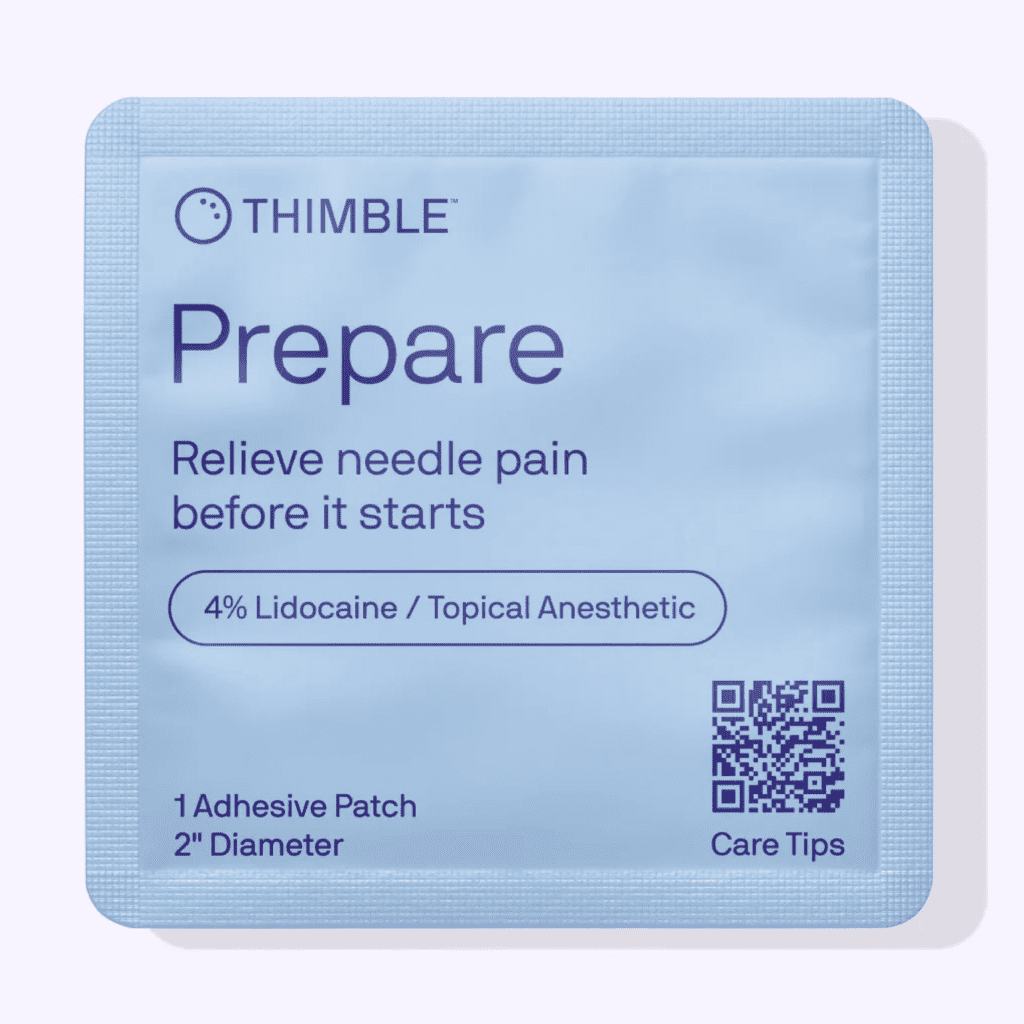
We created the Prepare Patch to solve for these issues. It’s fast, clean, and specifically designed for needle procedures. It delivers a precise dose of 4% lidocaine as efficiently as possible, while maintaining safety and ease of use. No mess. No prescription needed. Just peel, stick, and numb.
Managing post-injection pain and soreness
Meg Foundation: At the Meg Foundation, we advocate for evidence-based approaches—and there’s strong data supporting numbing the skin before needle procedures. But you’ve also created something for after the shot. Can you tell us more about that?
Dr. Dawkins: Absolutely. Reducing pain during a procedure is critical—it builds trust, reduces fear, and helps people access care without dread. That’s why we lead with Prepare.
But what we don’t talk about enough is what happens after the needle.
Pain doesn’t always end when the needle comes out. For many people, there’s lingering soreness, bruising, or swelling that lasts for hours or days. It interferes with sleep, work, childcare—you name it. I’ve seen people skip doses or avoid appointments simply because they don’t want to deal with the aftermath.
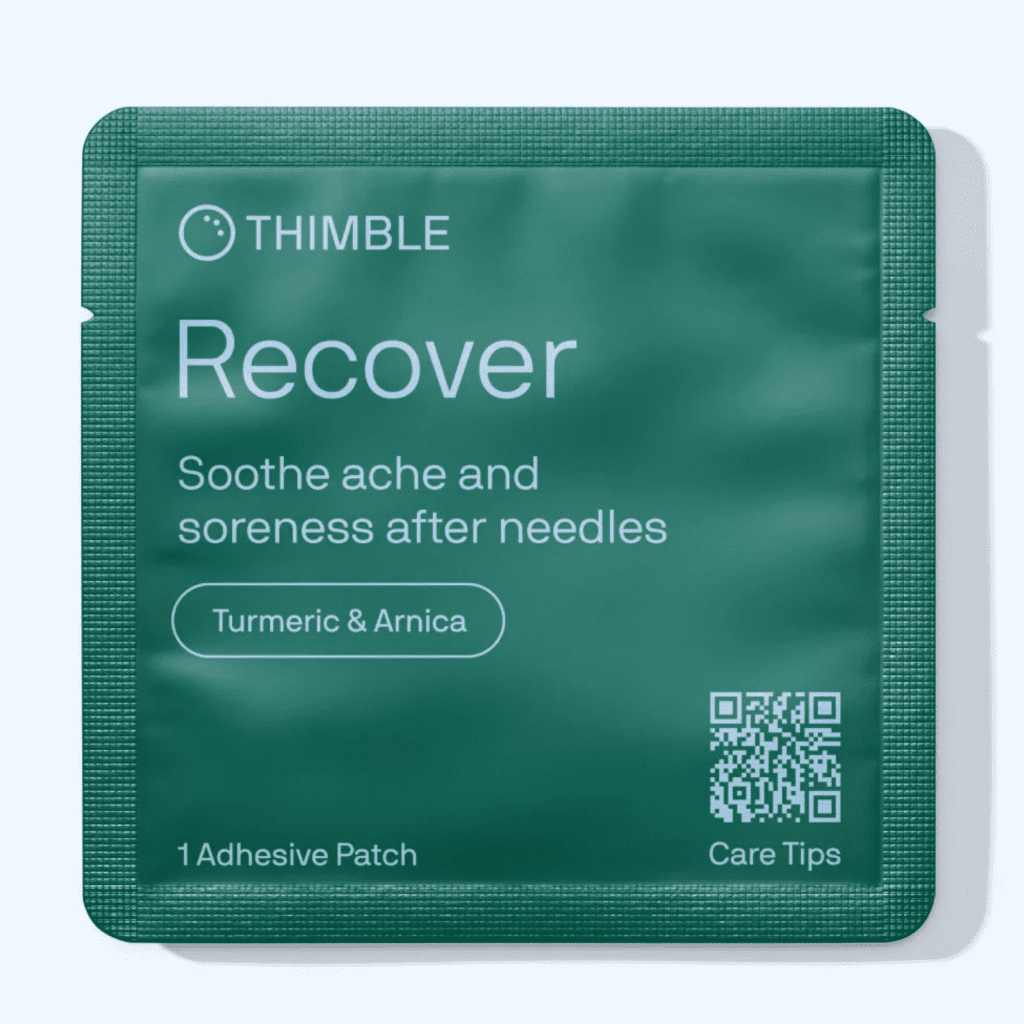
Pain is a teacher. It tells our bodies: avoid that. So if we don’t address post-injection pain, we’re reinforcing fear and avoidance. That’s why we created the Thimble Recover Patch—a plant-based, drug-free patch powered by turmeric and arnica. It provides up to 48 hours of localized relief right at the injection site.
How needle pain impacts healthcare access and trust
Meg Foundation: Why does this matter from a larger healthcare perspective?
Dr. Dawkins: When we care for pain—not just in the moment, but before and after—we’re sending a powerful message: What happened to you matters. You deserve to feel comfortable, supported, and safe.
This isn’t just about the individual. There’s evidence that when pain and anxiety are better managed, clinicians can perform procedures more efficiently and effectively. It improves the entire workflow—for patients and the healthcare team.
And from a systems perspective, it impacts access to healthcare, adherence to medical recommendations, and trust. Whether someone is going in for a routine flu shot or managing weekly injections of medication, the experience matters. If we want people to show up for their health, we need to show up for their pain.
Making needle procedures less painful for kids and adults
Meg Foundation: What’s your big-picture vision for Thimble?
Dr. Dawkins: We want to change the way people think about needle pain—before, during, and after. That includes the physical pain, yes, but also the emotional and psychological toll it can take.
We built Thimble to be accessible (over-the-counter), easy to use (no mess or complexity), and rooted in empathy. Our dream is for kids to grow up unafraid of shots, for adults to stay on track with their treatments, and for healthcare to feel a little more human.
When you offer care after a needle, you’re not just treating pain—you’re offering reassurance. You’re creating a memory of safety. And that, to me, is the kind of medicine that makes all the difference.
Meg Foundation: Thank you so much for sharing your story—and your solutions. We’re excited to watch Thimble grow and help make healthcare experiences better for everyone.
Dr. Dawkins: Thank you for the work you do! We’re proud to be part of the movement to make pain care for needle procedures accessible to all.
Connect with Thimble
YOU MAY ALSO BE INTERESTED IN
Downloads
Printable Comfort Poke Plan for Kids
We all do better with a plan! Use this to help kids create one of their very own before their next poke.
Digital Tool
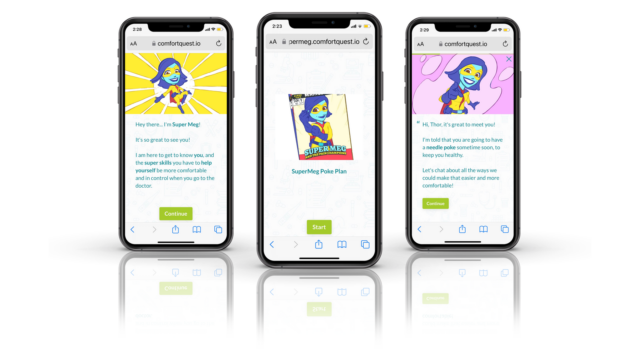
Take Control Mobile App for Teens
Meet the monsters helping your teen breathe easier, stress less, and take control during shots. Because doc visits don't have to be the actual worst.
Downloads
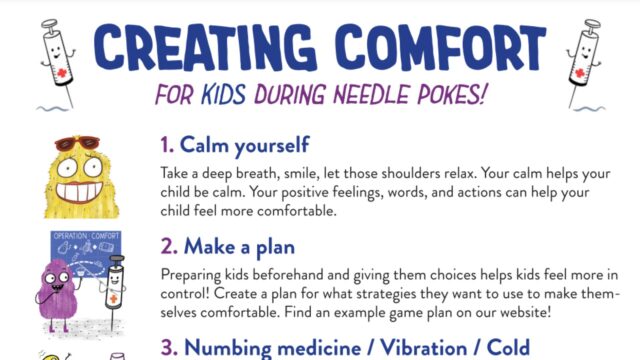
Creating Comfort for Kids Quick Guide
Great overview of the best pain management strategies for helping kids get through shots and other needle procedures feeling calm, comfortable, and in control.
Downloads
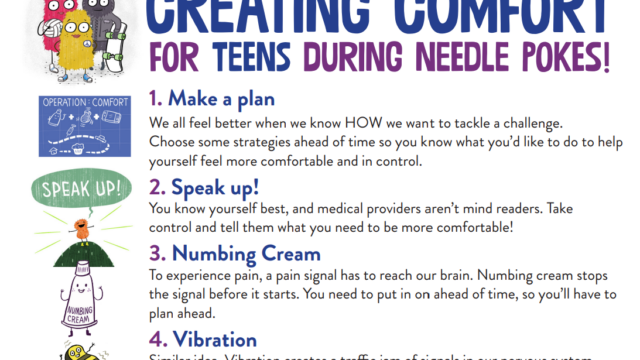
Creating Comfort for Teens Quick Guide
This infographic is a great overview of the best pain management strategies for helping teens get through shots and other needle procedures feeling calm, comfortable, and in control.

About the Author
Dr. Jody Thomas is a licensed clinical psychologist, and specialist in pediatric medical illness and trauma. A well-known expert in pediatric pain who teaches internationally on the subject, she is also a founder and the former Clinical Director of the Packard Pediatric Pain Rehabilitation Center at Stanford, and a former Assistant Professor at the Stanford University School of Medicine. Though she now lives in Denver, CO, she still serves as Adjunct Faculty for Stanford, providing supervision and teaching. As a consultant for the Lucile Packard Children’s Hospital at Stanford, she directs projects on the integration and innovation of pain management using tech-based intervention. Her passion for bringing together the power of medical science, technology and design to transform the way we think about kids and pain led her to her current focus but it’s her role as a mom of two that solidified her path in creating the Meg Foundation.